ANC One: from a request to finished work
Follow five real chat workflows through to their outputs: an estimate, proposal, design proofs, CRM update and operations report.
Start inside ANC One, describe the outcome, and review the actual result. This walkthrough uses clearly labelled Academy training material. ANC One itself remains a private, connected workspace; this lesson does not grant access.
In the video: 0:15 Estimate · 1:12 Proposal · 2:07 Design · 2:57 CRM · 3:44 Service operations · 4:27 All outputs.
The footage shows real requests and real outputs. Processing waits are shortened in the edit; generation is not instantaneous. Creating a document or proof does not send it, approve it or authorize a purchase.
Inspect the finished outputs
- Estimate: Editable Excel workbook. Nineteen worksheets, including the training summary; 289 recalculated formulas with no errors found.
- Proposal: Training budget proposal PDF. The total matches the estimate at $224,831.36. Training only, not for acceptance.
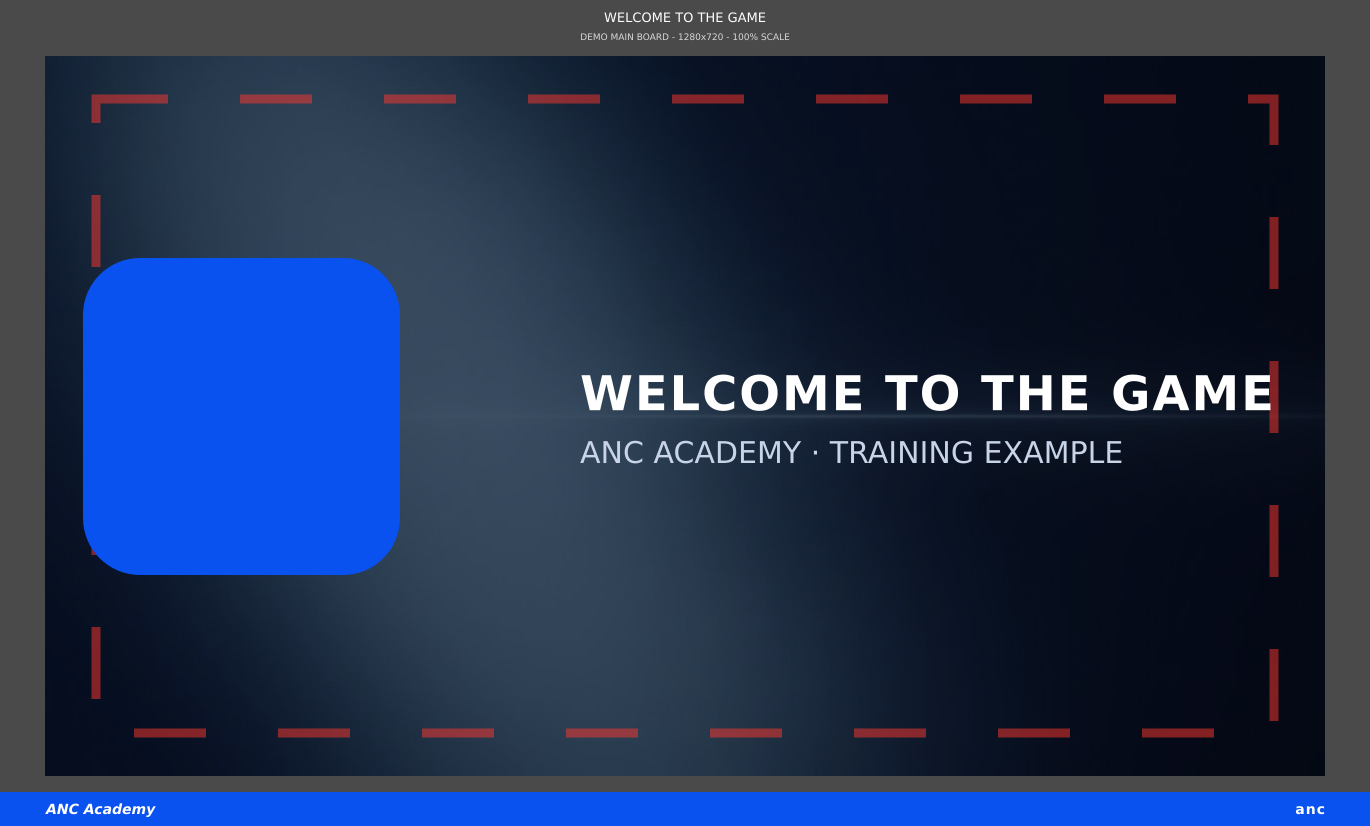
- Design: Main-board proof and ribbon proof. Review proofs, not paid native-size final files.
- CRM: Verified training-note PDF. The note was created, updated and read back from the CRM; it is not linked to a customer or opportunity.
- Service operations: One-page operations snapshot. Aggregate counts retrieved on September 11, 2026 at 14:53:25 UTC. This is a dated snapshot, not a continuously updating dashboard.

Estimate: state the assumptions
Describe the dimensions, pitch, environment, mounting and service access. State the pricing assumptions rather than letting them be guessed. In this training example, a 16 × 9 ft indoor wall uses 4 mm pitch, 35% margin, 5% contingency and 7% tax.
The workbook follows the estimator's convention: contingency on direct cost, tax on cost plus contingency, then margin. Its yellow input cells remain editable. These reference rates and assumptions are not an approved customer quote.
Proposal: carry the same figures forward
Continue the same conversation and ask for a budget proposal using the estimate. Check the final PDF against the workbook, including cents. The example contains scope, specifications, pricing and exclusions. It contains no signature request or acceptance authorization.
Design: review the actual boards
Supply the exact copy, colors, treatment and dimensions. The demo requests a static 1280 × 720 main board and a static 3840 × 240 ribbon. Proof images include their review surround and may be scaled; their PNG dimensions are not the native delivery dimensions.
Inspect the whole headline, subline and layout before approval. Paid final rendering is a separate action, with its cost and approval requirements preserved.
CRM: verify the saved change
The first request creates one unlinked training note. The follow-up changes that same note's title to ANC Academy Demo — ready for review and adds Estimate and proposal checked.
The walkthrough opens the CRM record itself and the exported PDF. Other records are not changed and no notification is sent.
Service operations: distinguish counts from conclusions
Ask for a read-only snapshot when you need context, not operational changes. The example includes venues, events, assignments, tickets and maintenance, with a definition beside each count.
An assignment count is not a headcount. An unassigned event count does not establish the staffing requirement. A maintenance count is not a count of unique venues or confirmed equipment failures.
A useful way to ask
Prepare the finished output for this task using the connected ANC system. Keep the supplied scope and figures unchanged, state any missing assumptions, and verify the result. Do not send, approve or change unrelated records.
Review before using the result
- Name the outcome and provide the scope or source file.
- State what may be changed and what must not be sent or approved.
- Open the delivered file or source record, not just the chat response.
- Check totals, dimensions, wording and retrieval dates.
- Apply the appropriate human review before production use.